> ## Documentation Index
> Fetch the complete documentation index at: https://tanso.mintlify.site/llms.txt
> Use this file to discover all available pages before exploring further.
# Internal AI spend
> Internal spend: pull your own Anthropic and OpenAI bills, reconcile them, allocate to teams and people, budget them, and read cost per shipped thing
Tanso has two halves. **Monetization**, everything else in these docs,
answers what it costs to serve each customer. **Internal spend** answers what
your own AI costs you: the Anthropic and OpenAI bills for your engineers and
agents, and what that spend produced.
It works from the vendors' admin APIs. Nothing sits in your request path and
nothing runs on anyone's laptop: connect an admin key, and Tanso pulls the
usage and cost reports the vendor already keeps. Everything lives under
**Internal spend** in the console and `/api/v1/spend/**` on the Admin API.
Either half runs on its own. `APP_MODULES_MONETIZATION_ENABLED=false` gives
you internal spend without the billing engine: plans, customers, credits,
invoices, the client API, Stripe and the billing jobs are off, their routes
answer `404` with `"code": "module_disabled"`, and the console opens on
Internal spend. `APP_MODULES_BUILD_ENABLED=false` is the reverse. Nothing
about the other half needs to be configured first, and flipping the flag
later needs no reinstall.
 ## 1. Connect a vendor
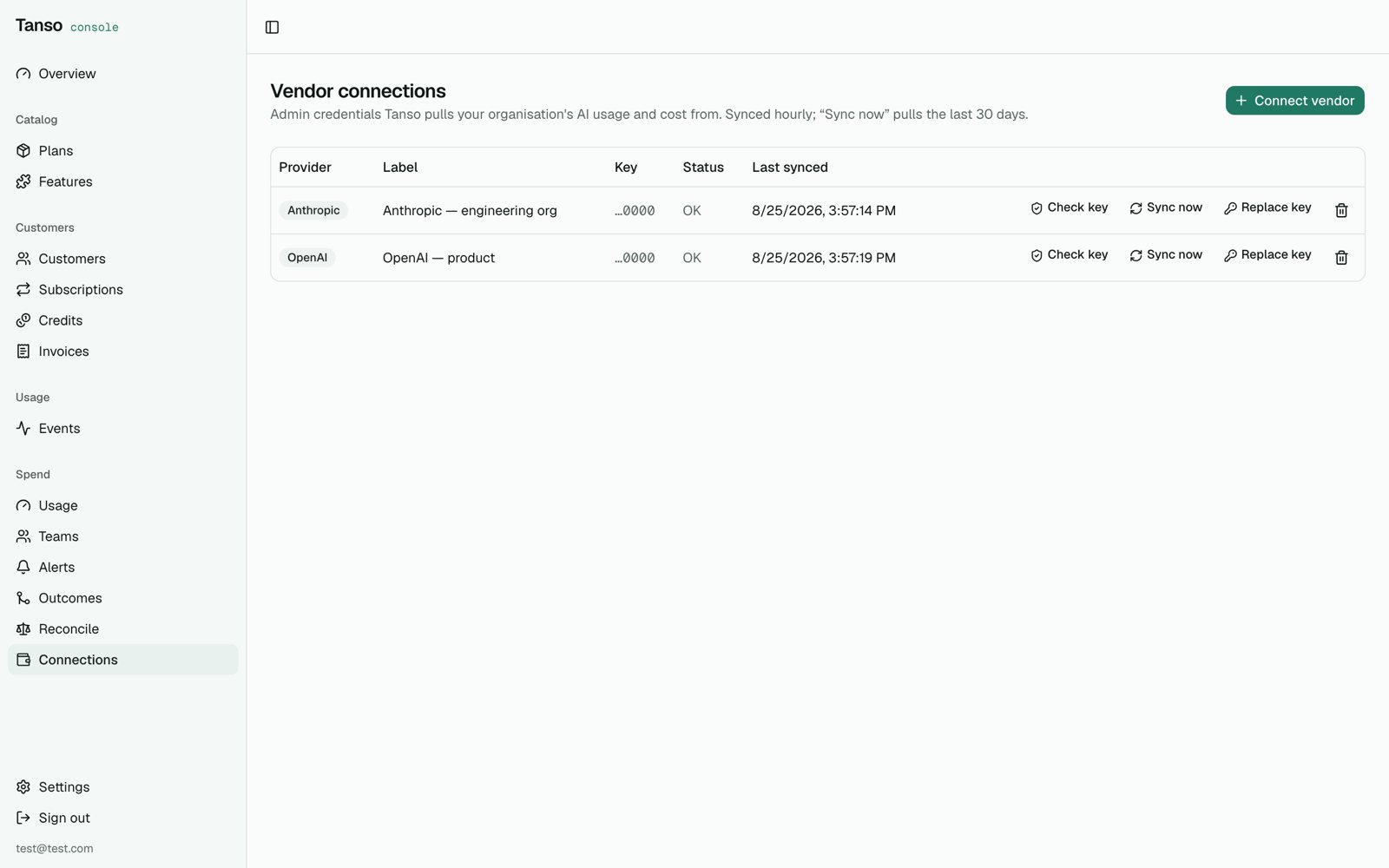 **Spend → Connections → Connect vendor.** Paste an Anthropic admin key
(`sk-ant-admin01-…`, created under Console → Settings → Organization), an
OpenAI admin key, a Cursor admin API key (Enterprise plan), a GitHub token
with the *View Organization Copilot Metrics* permission plus the org name, or
a LiteLLM proxy's master key plus the proxy URL. The key is encrypted at rest under `APP_SECRETS_KEY` and
only its last four characters are ever shown.
An Anthropic Console admin key has no read-only scope: it can administer the
whole organization. Use a dedicated reporting organization where you can, or
a Claude Enterprise scoped key if your org has one.
* **Check key** makes one cheap call and records `ACTIVE` or `ERROR` (with the
vendor's own message) on the row.
* **Sync now** pulls the last 30 days. After that an hourly job re-pulls the
last three days — vendor reports lag by up to an hour, so yesterday is never
final on the first pass.
* **Replace key** swaps a key that stopped working; pulled usage stays.
```bash theme={null}
POST /api/v1/spend/connections {"provider":"ANTHROPIC","label":"Engineering org","adminKey":"sk-ant-admin01-…"}
POST /api/v1/spend/connections/{id}/probe
POST /api/v1/spend/connections/{id}/sync?from=2026-08-01&to=2026-09-01 # [from, to), 31-day chunks
PUT /api/v1/spend/connections/{id}/key {"adminKey":"…"}
```
A vendor refusal comes back as `502` with `error.code: "vendor_error"` and
the vendor's message.
### What is pulled
| Vendor | Report | Dimensions |
| -------------- | ------------------------------------- | ------------------------------------------------------------------------------------------------------------------------------------------------------------- |
| Anthropic | `usage_report/messages` | model, workspace, API key, service tier; uncached / cache-read / cache-write / output tokens |
| Anthropic | `cost_report` | workspace, description; the vendor's price in cents |
| Anthropic | `usage_report/claude_code` | per user (email or key name), per model; tokens and the vendor's estimate |
| OpenAI | `usage/completions` | project, user, API key, model; cached tokens split out of input |
| OpenAI | `costs` | project, line item; dollars, stored as cents |
| Cursor | `teams/filtered-usage-events` | per person and model per day: tokens incl. cache, requests, and what Cursor actually charged |
| Cursor | `teams/daily-usage-data` | per person per day: accepted lines, accepts/rejects, tab accepts, agent/chat/composer requests |
| GitHub Copilot | `copilot/metrics/reports/users-1-day` | per person per day: interactions, accepted code, lines, AI credits; CLI/app tokens. No dollar figure — GitHub says credits are not for invoicing |
| LiteLLM | `spend/logs` | per team, key and user per day, per model: prompt/completion tokens, requests, and the spend LiteLLM computed — every provider behind the proxy in one source |
Rows land in `vendor_usage_buckets` in the vendor's own dimensions. A window
is deleted and rewritten on every pull, so re-syncing is idempotent.
Per-person data is uneven and Tanso says so rather than guessing: Anthropic
reports people only for Claude Code; OpenAI only for user-scoped keys; Cursor
and Copilot per seat; usage through Bedrock or Vertex is invisible to all of
them. Cursor windows are capped at 30 days by Cursor; a longer sync is pulled
in 30-day chunks.
## 2. Usage
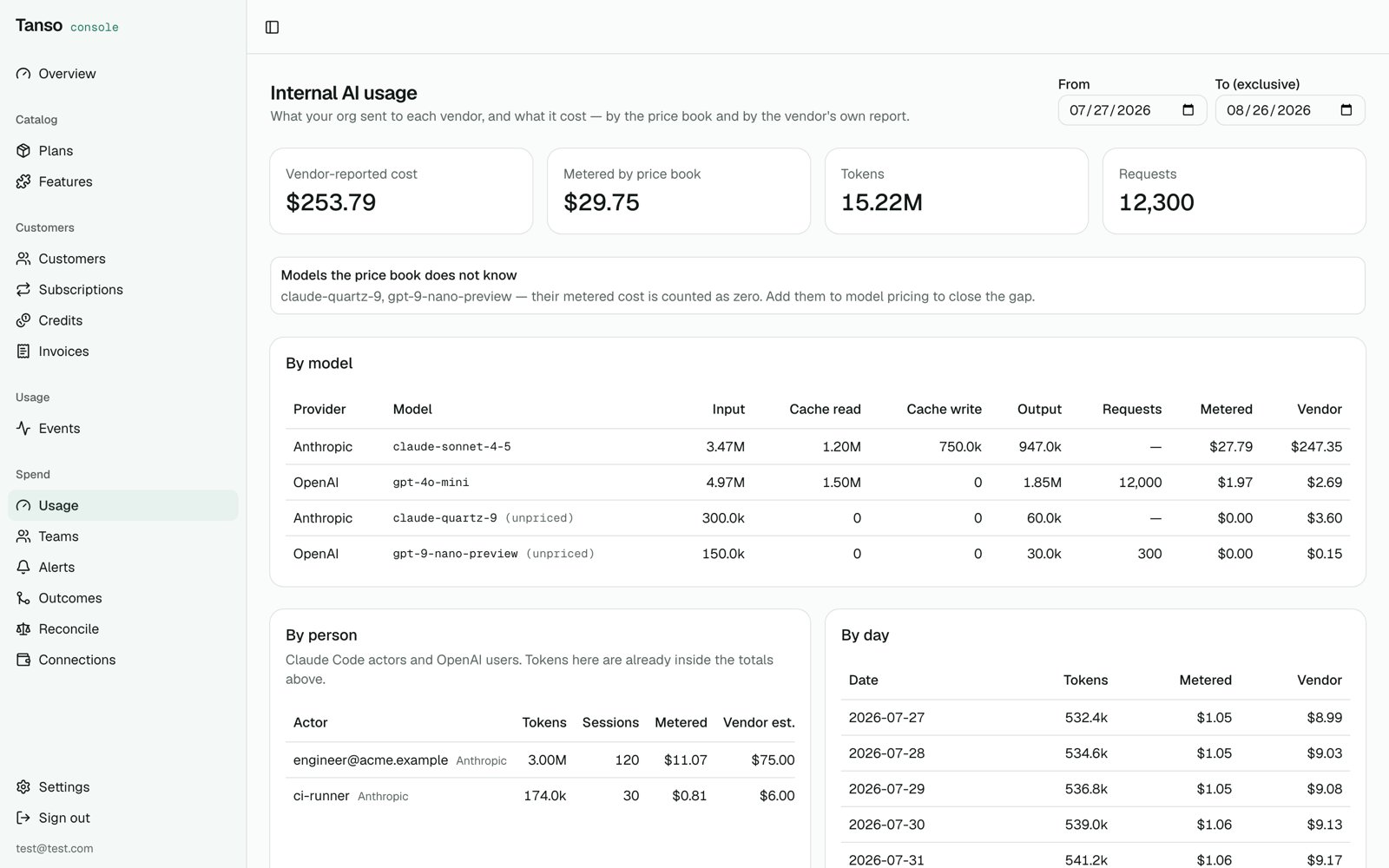
**Spend → Usage** shows a window by model, by day, and by person, two ways:
* **Metered** — tokens × the price book (`model_pricing`, including cache
read/write rates). A model the price book does not know prices to zero and
is named in `unpricedModels`; a model without cache rates prices cached
tokens at the full input rate and is marked `~cache`.
* **Vendor** — what the vendor's own cost report says.
Token totals come from usage reports only. Claude Code rows are the same
traffic seen per person, so they appear under **By person** and are never
added on top.
**By person** also shows what each vendor reports per seat, beside cost:
Claude Code sessions, commits, pull requests and tool accept/reject; Cursor
accepted lines, accepts/rejects and requests; Copilot interactions, accepted
code and AI credits. A column is empty where the vendor reports nothing.
These rows only exist while person-level attribution is on.
```bash theme={null}
GET /api/v1/spend/reports/usage?from=2026-08-01&to=2026-09-01 # to is exclusive
```
## 3. Reconcile
**Spend → Connections → Connect vendor.** Paste an Anthropic admin key
(`sk-ant-admin01-…`, created under Console → Settings → Organization), an
OpenAI admin key, a Cursor admin API key (Enterprise plan), a GitHub token
with the *View Organization Copilot Metrics* permission plus the org name, or
a LiteLLM proxy's master key plus the proxy URL. The key is encrypted at rest under `APP_SECRETS_KEY` and
only its last four characters are ever shown.
An Anthropic Console admin key has no read-only scope: it can administer the
whole organization. Use a dedicated reporting organization where you can, or
a Claude Enterprise scoped key if your org has one.
* **Check key** makes one cheap call and records `ACTIVE` or `ERROR` (with the
vendor's own message) on the row.
* **Sync now** pulls the last 30 days. After that an hourly job re-pulls the
last three days — vendor reports lag by up to an hour, so yesterday is never
final on the first pass.
* **Replace key** swaps a key that stopped working; pulled usage stays.
```bash theme={null}
POST /api/v1/spend/connections {"provider":"ANTHROPIC","label":"Engineering org","adminKey":"sk-ant-admin01-…"}
POST /api/v1/spend/connections/{id}/probe
POST /api/v1/spend/connections/{id}/sync?from=2026-08-01&to=2026-09-01 # [from, to), 31-day chunks
PUT /api/v1/spend/connections/{id}/key {"adminKey":"…"}
```
A vendor refusal comes back as `502` with `error.code: "vendor_error"` and
the vendor's message.
### What is pulled
| Vendor | Report | Dimensions |
| -------------- | ------------------------------------- | ------------------------------------------------------------------------------------------------------------------------------------------------------------- |
| Anthropic | `usage_report/messages` | model, workspace, API key, service tier; uncached / cache-read / cache-write / output tokens |
| Anthropic | `cost_report` | workspace, description; the vendor's price in cents |
| Anthropic | `usage_report/claude_code` | per user (email or key name), per model; tokens and the vendor's estimate |
| OpenAI | `usage/completions` | project, user, API key, model; cached tokens split out of input |
| OpenAI | `costs` | project, line item; dollars, stored as cents |
| Cursor | `teams/filtered-usage-events` | per person and model per day: tokens incl. cache, requests, and what Cursor actually charged |
| Cursor | `teams/daily-usage-data` | per person per day: accepted lines, accepts/rejects, tab accepts, agent/chat/composer requests |
| GitHub Copilot | `copilot/metrics/reports/users-1-day` | per person per day: interactions, accepted code, lines, AI credits; CLI/app tokens. No dollar figure — GitHub says credits are not for invoicing |
| LiteLLM | `spend/logs` | per team, key and user per day, per model: prompt/completion tokens, requests, and the spend LiteLLM computed — every provider behind the proxy in one source |
Rows land in `vendor_usage_buckets` in the vendor's own dimensions. A window
is deleted and rewritten on every pull, so re-syncing is idempotent.
Per-person data is uneven and Tanso says so rather than guessing: Anthropic
reports people only for Claude Code; OpenAI only for user-scoped keys; Cursor
and Copilot per seat; usage through Bedrock or Vertex is invisible to all of
them. Cursor windows are capped at 30 days by Cursor; a longer sync is pulled
in 30-day chunks.
## 2. Usage
**Spend → Usage** shows a window by model, by day, and by person, two ways:
* **Metered** — tokens × the price book (`model_pricing`, including cache
read/write rates). A model the price book does not know prices to zero and
is named in `unpricedModels`; a model without cache rates prices cached
tokens at the full input rate and is marked `~cache`.
* **Vendor** — what the vendor's own cost report says.
Token totals come from usage reports only. Claude Code rows are the same
traffic seen per person, so they appear under **By person** and are never
added on top.
**By person** also shows what each vendor reports per seat, beside cost:
Claude Code sessions, commits, pull requests and tool accept/reject; Cursor
accepted lines, accepts/rejects and requests; Copilot interactions, accepted
code and AI credits. A column is empty where the vendor reports nothing.
These rows only exist while person-level attribution is on.
```bash theme={null}
GET /api/v1/spend/reports/usage?from=2026-08-01&to=2026-09-01 # to is exclusive
```
## 3. Reconcile
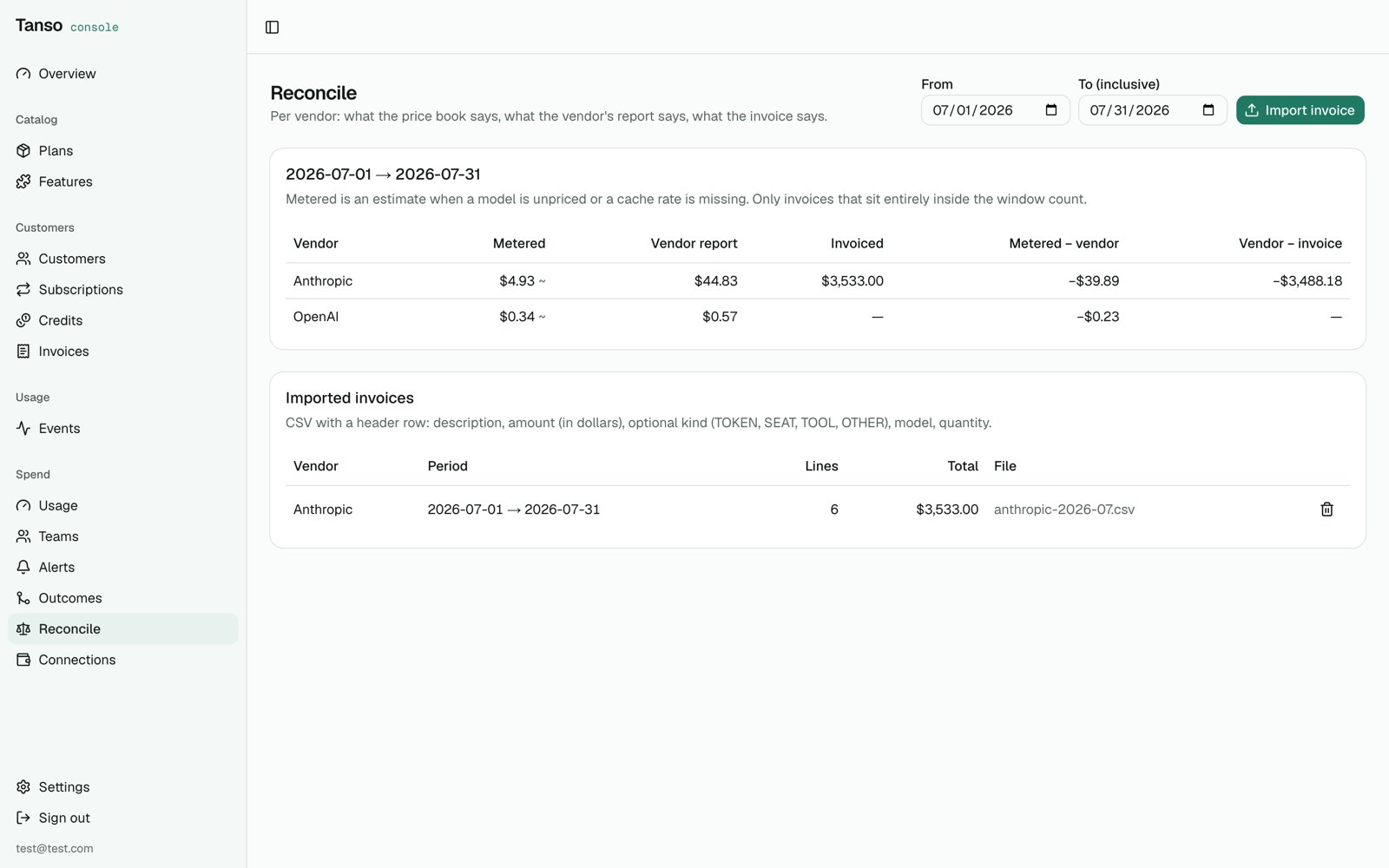 **Spend → Reconcile** compares one period three ways per vendor: metered,
vendor-reported, and invoiced, with the two variances. Dates here are
inclusive — invoices are dated, not timestamped.
Import the bill as a CSV with a header row: `description`, `amount` (in
dollars), and optionally `kind` (`TOKEN`, `SEAT`, `TOOL`, `OTHER`), `model`,
`quantity`. Seat lines count toward "invoiced" but never appear in a token
cost report, so "vendor − invoice" carries the seats. An invoice only counts
toward a window it sits entirely inside; a straddling one is not pro-rated.
```bash theme={null}
curl -X POST https://YOUR-INSTANCE/api/v1/spend/invoices \
-H "Authorization: Bearer $JWT" \
-F provider=ANTHROPIC -F periodStart=2026-07-01 -F periodEnd=2026-07-31 \
-F currency=USD -F file=@july.csv
GET /api/v1/spend/reports/reconcile?from=2026-07-01&to=2026-07-31
```
## 4. Teams, people and rules
**Spend → Reconcile** compares one period three ways per vendor: metered,
vendor-reported, and invoiced, with the two variances. Dates here are
inclusive — invoices are dated, not timestamped.
Import the bill as a CSV with a header row: `description`, `amount` (in
dollars), and optionally `kind` (`TOKEN`, `SEAT`, `TOOL`, `OTHER`), `model`,
`quantity`. Seat lines count toward "invoiced" but never appear in a token
cost report, so "vendor − invoice" carries the seats. An invoice only counts
toward a window it sits entirely inside; a straddling one is not pro-rated.
```bash theme={null}
curl -X POST https://YOUR-INSTANCE/api/v1/spend/invoices \
-H "Authorization: Bearer $JWT" \
-F provider=ANTHROPIC -F periodStart=2026-07-01 -F periodEnd=2026-07-31 \
-F currency=USD -F file=@july.csv
GET /api/v1/spend/reports/reconcile?from=2026-07-01&to=2026-07-31
```
## 4. Teams, people and rules
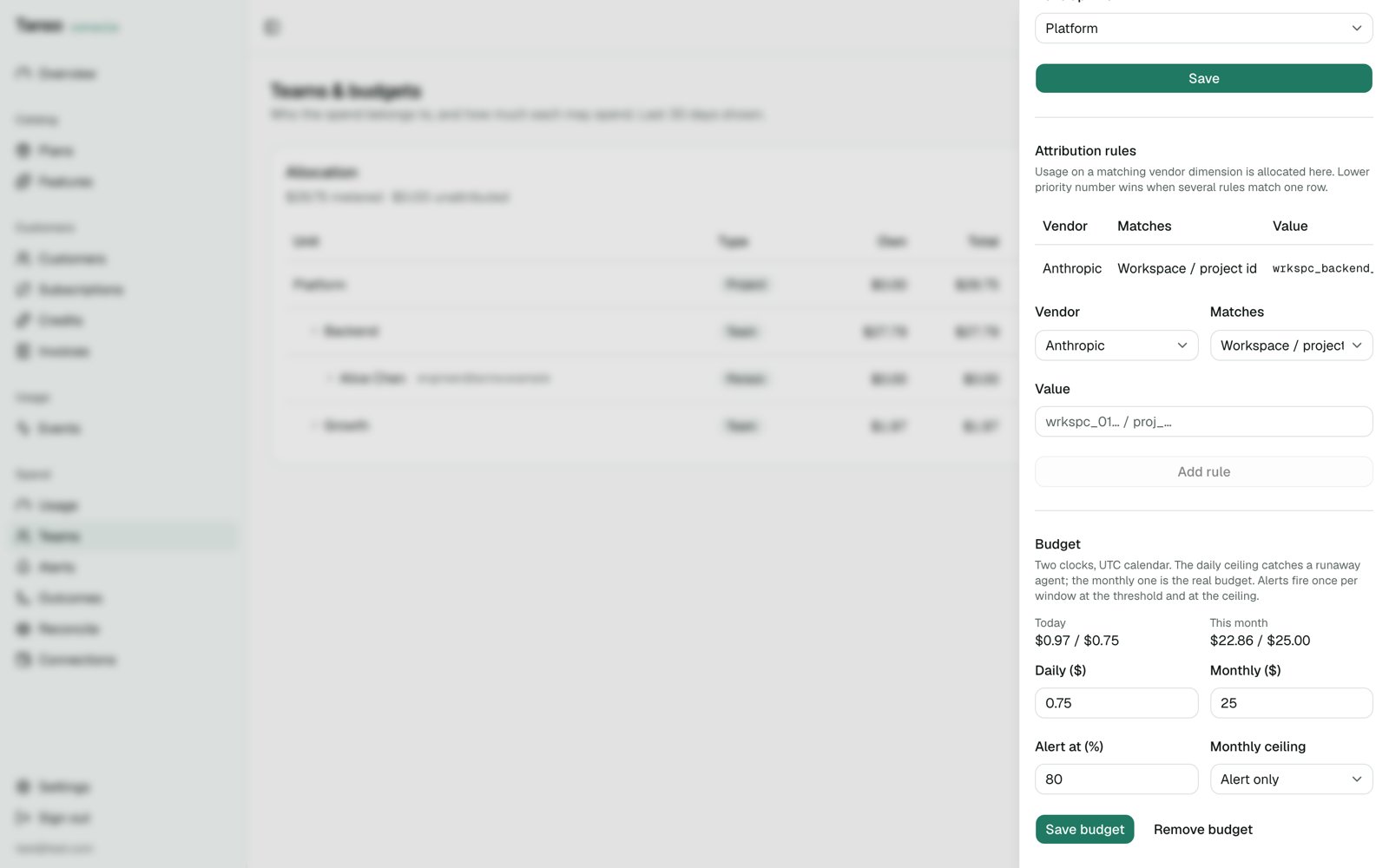
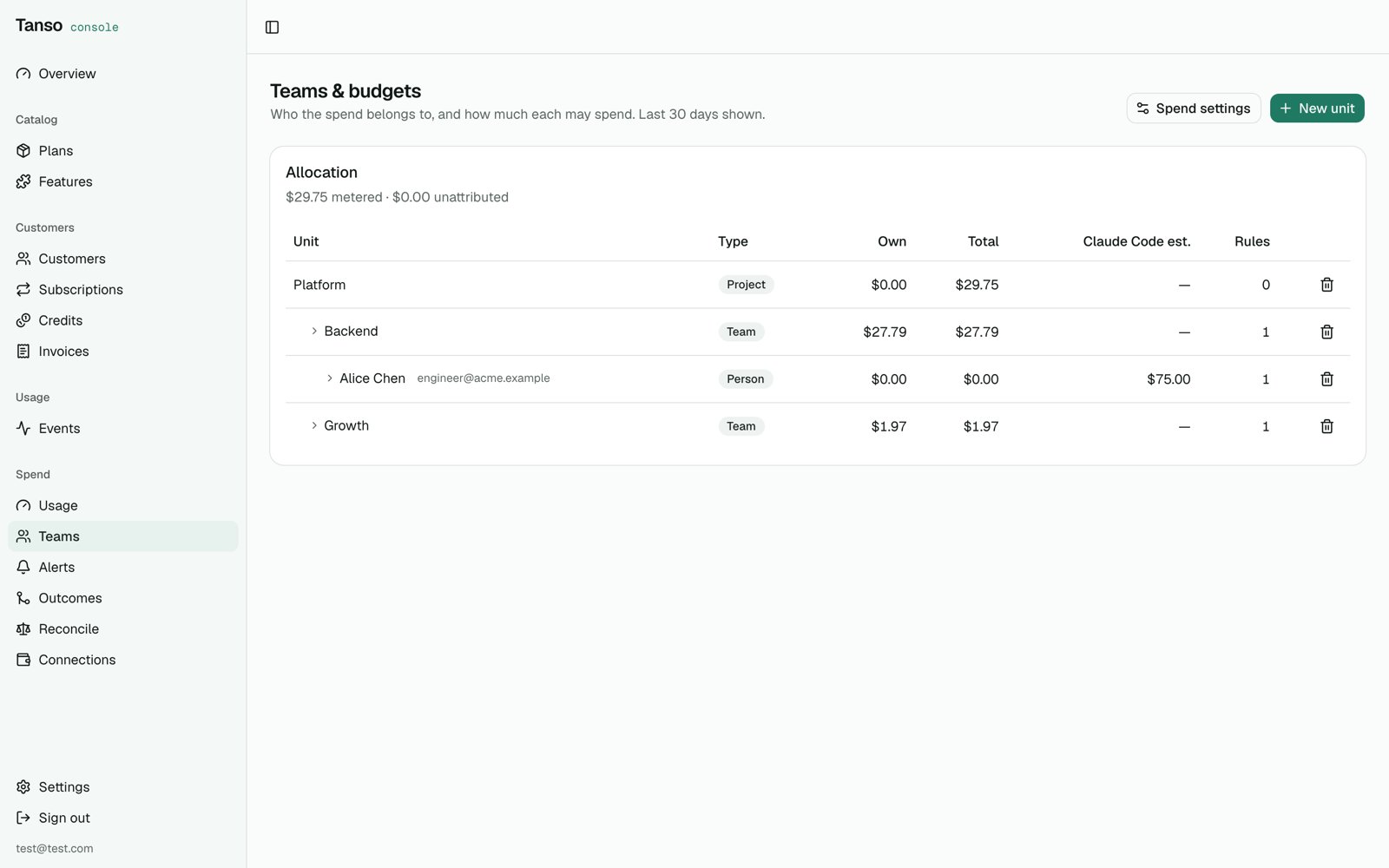 **Spend → Teams.** A **unit** is a team, a project, or a person; units nest,
and a unit's total is its own spend plus every descendant's.
An **attribution rule** maps a vendor dimension onto a unit:
| `matchKind` | Matches |
| -------------- | ------------------------------------------- |
| `WORKSPACE_ID` | Anthropic workspace id or OpenAI project id |
| `API_KEY_ID` | The vendor's API key id |
| `ACTOR` | Claude Code email or OpenAI user id |
Rules apply at report time, never materialised — edit one and history
re-allocates. When several rules match one row, the lowest `priority` number
wins. Whatever no rule claims shows as **Unattributed**, and always sums with
the rows back to the metered total.
```bash theme={null}
POST /api/v1/spend/units {"type":"TEAM","name":"Backend","parentId":"…"}
POST /api/v1/spend/rules {"spendUnitId":"…","provider":"ANTHROPIC","matchKind":"WORKSPACE_ID","matchValue":"wrkspc_01…","priority":100}
GET /api/v1/spend/reports/allocation?from=&to=
```
**Spend → Teams.** A **unit** is a team, a project, or a person; units nest,
and a unit's total is its own spend plus every descendant's.
An **attribution rule** maps a vendor dimension onto a unit:
| `matchKind` | Matches |
| -------------- | ------------------------------------------- |
| `WORKSPACE_ID` | Anthropic workspace id or OpenAI project id |
| `API_KEY_ID` | The vendor's API key id |
| `ACTOR` | Claude Code email or OpenAI user id |
Rules apply at report time, never materialised — edit one and history
re-allocates. When several rules match one row, the lowest `priority` number
wins. Whatever no rule claims shows as **Unattributed**, and always sums with
the rows back to the metered total.
```bash theme={null}
POST /api/v1/spend/units {"type":"TEAM","name":"Backend","parentId":"…"}
POST /api/v1/spend/rules {"spendUnitId":"…","provider":"ANTHROPIC","matchKind":"WORKSPACE_ID","matchValue":"wrkspc_01…","priority":100}
GET /api/v1/spend/reports/allocation?from=&to=
```
 ### Person-level attribution is off by default
Attributing spend to a named employee is a monitoring capability — in Germany
a works council can veto it. The switch under **Spend settings** stays off
until you have written the **worker notice**: what staff were told. While it
is off, people cannot be created, person rules are skipped, and the by-person
view stays empty.
A person's Claude Code estimate is shown on the person and **not** rolled up
into the team: the same traffic already reaches the team through its key
rules.
## 5. Budgets and alerts
Each unit can carry two ceilings on UTC calendar windows:
* a **daily** ceiling, small, to catch a runaway agent within the day;
* a **monthly** ceiling, the real number.
An alert fires once per (unit, kind, window):
| Kind | When |
| ----------- | ------------------------------------------------------------------------------ |
| `THRESHOLD` | spend crosses `alertThreshold` % of a ceiling (default 80) |
| `BREACH` | spend crosses the ceiling |
| `SPIKE` | today is at least \$5 and more than twice the trailing-seven-day daily average |
### Person-level attribution is off by default
Attributing spend to a named employee is a monitoring capability — in Germany
a works council can veto it. The switch under **Spend settings** stays off
until you have written the **worker notice**: what staff were told. While it
is off, people cannot be created, person rules are skipped, and the by-person
view stays empty.
A person's Claude Code estimate is shown on the person and **not** rolled up
into the team: the same traffic already reaches the team through its key
rules.
## 5. Budgets and alerts
Each unit can carry two ceilings on UTC calendar windows:
* a **daily** ceiling, small, to catch a runaway agent within the day;
* a **monthly** ceiling, the real number.
An alert fires once per (unit, kind, window):
| Kind | When |
| ----------- | ------------------------------------------------------------------------------ |
| `THRESHOLD` | spend crosses `alertThreshold` % of a ceiling (default 80) |
| `BREACH` | spend crosses the ceiling |
| `SPIKE` | today is at least \$5 and more than twice the trailing-seven-day daily average |
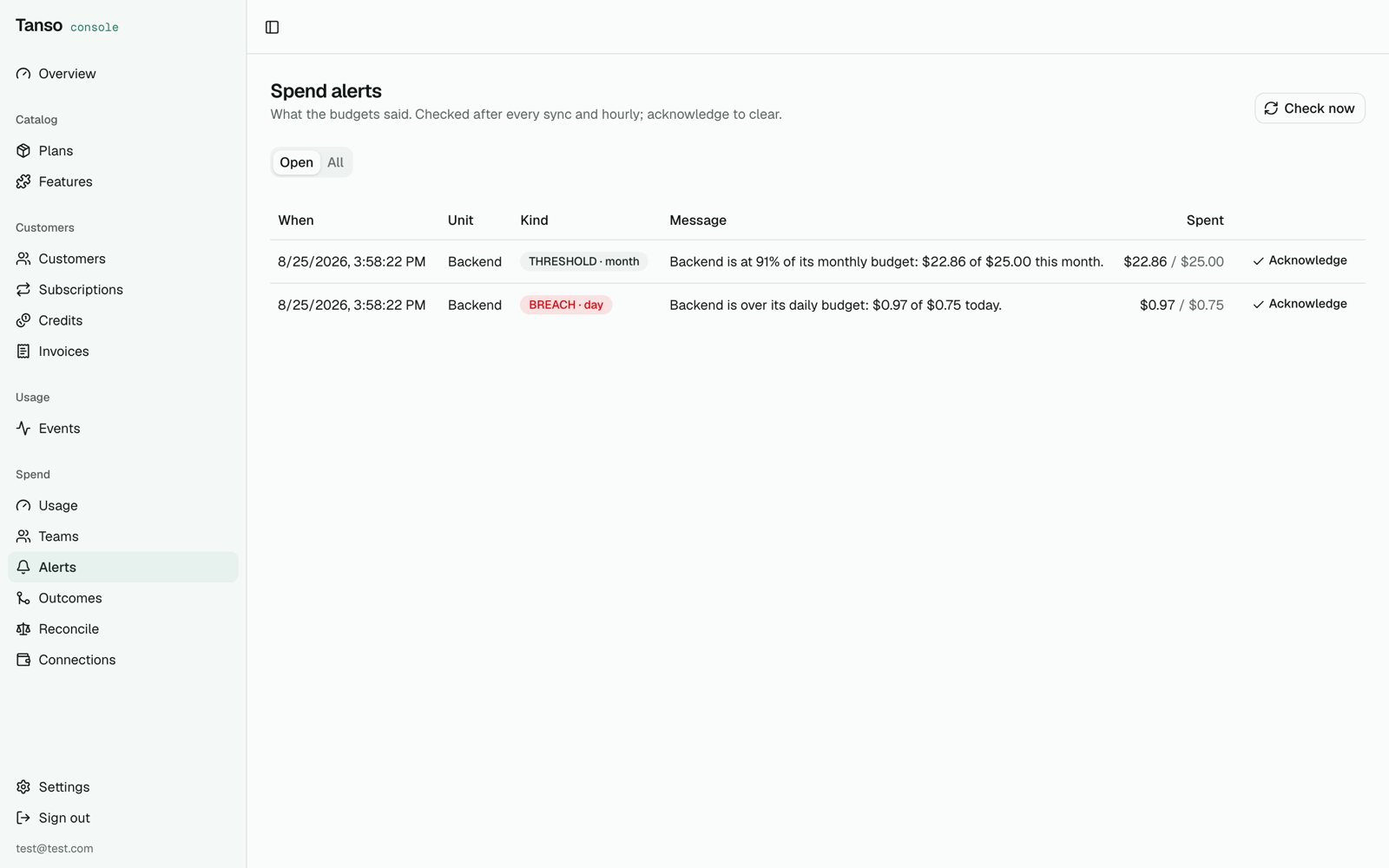 Budgets are checked after every sync and hourly; **Spend → Alerts** lists
what fired, **Acknowledge** clears it. Store a Slack incoming webhook under
Spend settings (it is stored encrypted and never shown again) and each alert
is posted there as it fires.
Tanso is not in your request path, so on its own a budget cannot stop a
request. A budget set to **Block** only alerts — its message says so — unless
a gateway is connected (below). Without one, enforce at your gateway by hand
(Portkey and Bifrost also take per-key budgets) or revoke the key.
### Where alerts go
Under **Spend → Teams → Settings**:
| Channel | What is sent | Setup |
| ------- | ------------------------------------------------------------------------------------------------------------------------------------------------------------------------------------------------------------------- | ------------------------------------------------------------------------------------------- |
| Slack | one line per alert; the digest as text | an incoming webhook URL (`https://hooks.slack.com/…`) |
| Webhook | `POST` JSON: `{"type":"spend.alert","accountId":…,"alert":{…}}` or `{"type":"spend.digest",…,"digest":{…}}`; header `X-Tanso-Event`; with a secret, `X-Tanso-Signature: sha256=` | any https URL, optional signing secret — both stored encrypted |
| Email | subject + text and an HTML table for the digest | comma-separated addresses; the server needs `APP_RESEND_API_KEY` and `APP_SPEND_ALERT_FROM` |
Each channel fails on its own and is logged; an alert is recorded before any
of them is tried, so a dead endpoint never loses it.
Payload shape: `{"type":"spend.alert","accountId":"…","alert":{…the alert
as GET /alerts returns it…}}` or `{"type":"spend.digest","accountId":"…",
"digest":{…as GET /digest…}}`. `POST /digest/send` answers with a `delivery`
block — `slack` / `webhook` / `email` each `SENT`, `FAILED` or
`NOT_CONFIGURED` — and the console toast says the same, so a dead email leg
is never reported as sent. The Slack field only accepts `hooks.slack.com`
URLs; anything else goes in the webhook field.
Verify a signature in Node:
```js theme={null}
const sig = "sha256=" + crypto.createHmac("sha256", secret).update(rawBody).digest("hex");
```
### Projected overspend
Once a month, when at least a fifth of the month has passed and the unit is
still under its ceiling, Tanso projects month-to-date spend straight-line
(`spent × month length / elapsed`) and fires **Projected** if that lands above
the ceiling — "Backend is on pace for $214 this month against a $200 budget."
One heavy day early in the month would project to anything, hence the wait.
The pace is `spent × (seconds in month ÷ seconds elapsed)` at the moment of
the check.
### Temporary bump
A launch week should not mean editing the real budget. On the unit's budget
card, **Temporary bump** takes an amount above the standing ceiling, an end
date and a reason. Until then the bump is the ceiling — for alerts, for the
digest and for the gateway push; after, the standing number is back and, for a
Block budget, re-pushed to LiteLLM. **End now** drops it early.
### Weekly digest
Budgets are checked after every sync and hourly; **Spend → Alerts** lists
what fired, **Acknowledge** clears it. Store a Slack incoming webhook under
Spend settings (it is stored encrypted and never shown again) and each alert
is posted there as it fires.
Tanso is not in your request path, so on its own a budget cannot stop a
request. A budget set to **Block** only alerts — its message says so — unless
a gateway is connected (below). Without one, enforce at your gateway by hand
(Portkey and Bifrost also take per-key budgets) or revoke the key.
### Where alerts go
Under **Spend → Teams → Settings**:
| Channel | What is sent | Setup |
| ------- | ------------------------------------------------------------------------------------------------------------------------------------------------------------------------------------------------------------------- | ------------------------------------------------------------------------------------------- |
| Slack | one line per alert; the digest as text | an incoming webhook URL (`https://hooks.slack.com/…`) |
| Webhook | `POST` JSON: `{"type":"spend.alert","accountId":…,"alert":{…}}` or `{"type":"spend.digest",…,"digest":{…}}`; header `X-Tanso-Event`; with a secret, `X-Tanso-Signature: sha256=` | any https URL, optional signing secret — both stored encrypted |
| Email | subject + text and an HTML table for the digest | comma-separated addresses; the server needs `APP_RESEND_API_KEY` and `APP_SPEND_ALERT_FROM` |
Each channel fails on its own and is logged; an alert is recorded before any
of them is tried, so a dead endpoint never loses it.
Payload shape: `{"type":"spend.alert","accountId":"…","alert":{…the alert
as GET /alerts returns it…}}` or `{"type":"spend.digest","accountId":"…",
"digest":{…as GET /digest…}}`. `POST /digest/send` answers with a `delivery`
block — `slack` / `webhook` / `email` each `SENT`, `FAILED` or
`NOT_CONFIGURED` — and the console toast says the same, so a dead email leg
is never reported as sent. The Slack field only accepts `hooks.slack.com`
URLs; anything else goes in the webhook field.
Verify a signature in Node:
```js theme={null}
const sig = "sha256=" + crypto.createHmac("sha256", secret).update(rawBody).digest("hex");
```
### Projected overspend
Once a month, when at least a fifth of the month has passed and the unit is
still under its ceiling, Tanso projects month-to-date spend straight-line
(`spent × month length / elapsed`) and fires **Projected** if that lands above
the ceiling — "Backend is on pace for $214 this month against a $200 budget."
One heavy day early in the month would project to anything, hence the wait.
The pace is `spent × (seconds in month ÷ seconds elapsed)` at the moment of
the check.
### Temporary bump
A launch week should not mean editing the real budget. On the unit's budget
card, **Temporary bump** takes an amount above the standing ceiling, an end
date and a reason. Until then the bump is the ceiling — for alerts, for the
digest and for the gateway push; after, the standing number is back and, for a
Block budget, re-pushed to LiteLLM. **End now** drops it early.
### Weekly digest
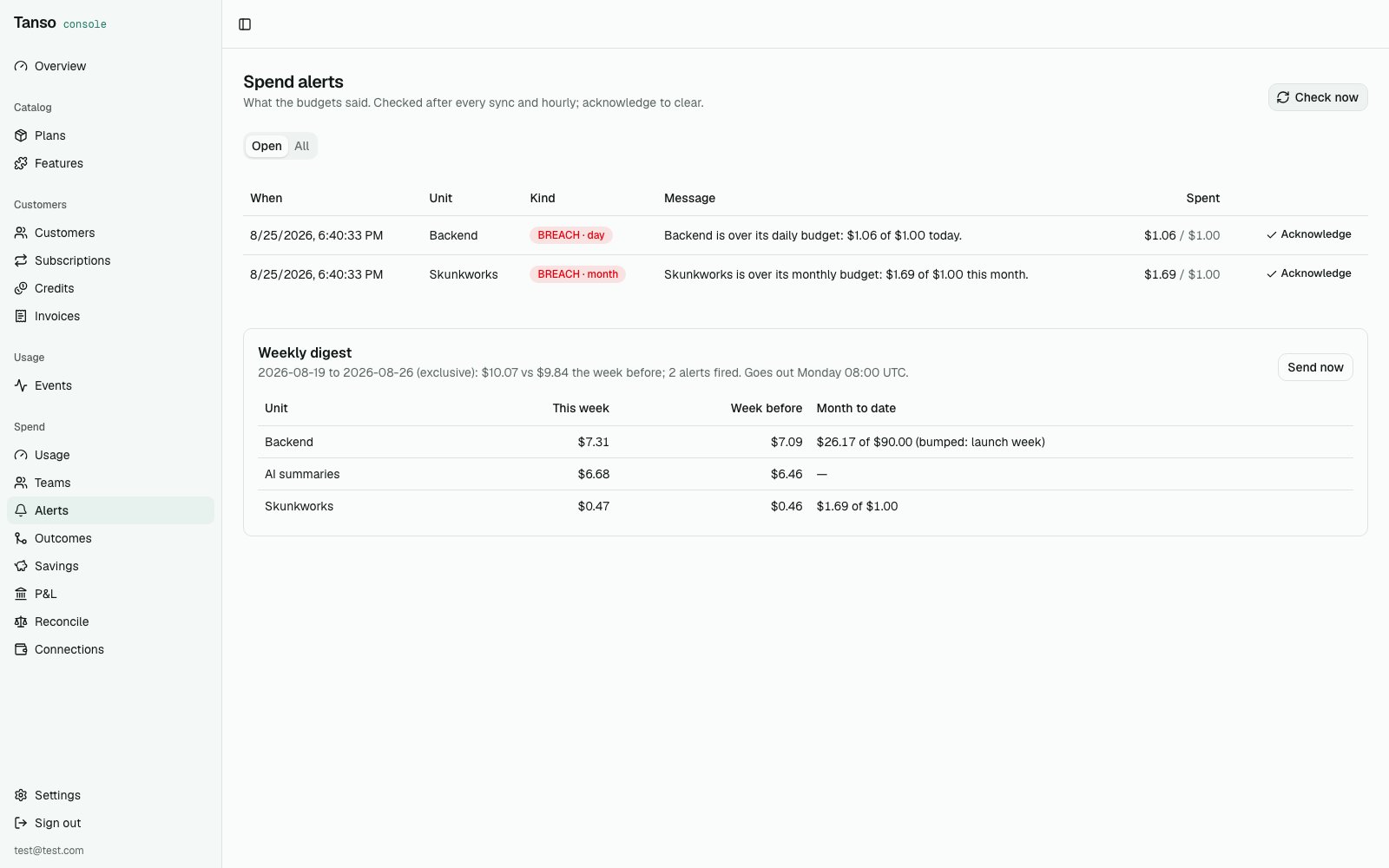 Switch it on under Settings; it goes out Monday 08:00 UTC to every configured
channel: the last seven full UTC days (yesterday back, today excluded) per
unit against the seven before, month-to-date
against the ceiling in force (with any bump's reason), unattributed spend and
how many alerts fired. **Spend → Alerts** previews it and has **Send now**.
### Gateway mode: enforce at LiteLLM
Switch it on under Settings; it goes out Monday 08:00 UTC to every configured
channel: the last seven full UTC days (yesterday back, today excluded) per
unit against the seven before, month-to-date
against the ceiling in force (with any bump's reason), unattributed spend and
how many alerts fired. **Spend → Alerts** previews it and has **Send now**.
### Gateway mode: enforce at LiteLLM
 If your traffic already goes through a [LiteLLM proxy](https://docs.litellm.ai/docs/proxy/users),
Tanso can make Block real:
1. **Spend → Connections → Connect vendor**, provider *LiteLLM*: the proxy URL
and its master key. *Check key* calls `/health/liveliness`; *Sync now*
pulls `/spend/logs`.
2. On the unit, add a rule with provider *LiteLLM*: *Workspace* = the LiteLLM
`team_id`, *API key* = the key, or *Actor* = the internal `user_id`.
3. Set the monthly ceiling and mode **Block**, save.
Tanso then calls `/team/update`, `/key/update` or `/user/update` with
`max_budget` (the ceiling in dollars) and `budget_duration: "1mo"`. LiteLLM
refuses requests once its own spend on that object passes the ceiling and
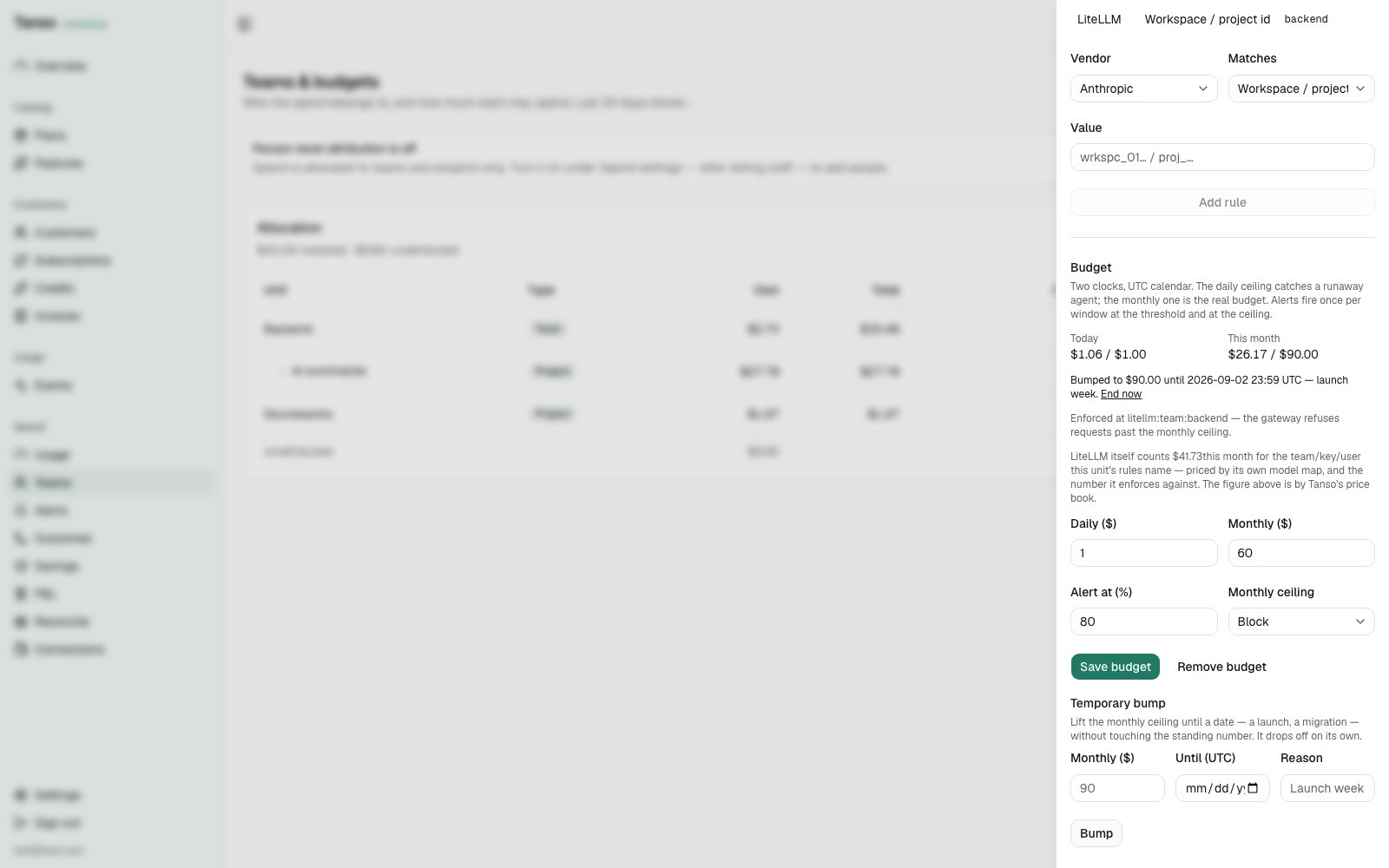
resets it monthly. The budget card shows *Enforced at litellm:team:backend*
and the breach alert says the same; if the push failed it shows *Not
enforced:* with LiteLLM's error, and the budget still saves. Switching the
mode back to Alert — or deleting the budget — pushes `max_budget: null` so no
stale limit stays behind.
Only the monthly ceiling is pushed; LiteLLM keeps one duration per object, so
the daily ceiling stays an alert. A bump pushes the bumped ceiling and its
expiry pushes the standing one back; a push that fails still saves the budget
and shows *Not enforced* with the proxy's error.
**Two clocks.** Tanso measures a budget on its own price book; LiteLLM
enforces `max_budget` against spend it priced from its own model map. They
drift when the maps differ, and the gateway may block well before or after
Tanso's alert. The budget card therefore also shows *LiteLLM itself counts
\$…* — the proxy's month-to-date for the team/key/user the unit's rules name
(`gatewaySpentCents` on the API). If the two disagree by more than the odd
percent, fix the price book (Settings → Model pricing) or the proxy's
`model_cost_map`.
```bash theme={null}
PUT /api/v1/spend/units/{id}/budget {"dailyCents":2500,"monthlyCents":50000,"alertThreshold":80,"monthlyMode":"ALERT"}
POST /api/v1/spend/budgets/evaluate # returns what fired this time
GET /api/v1/spend/alerts?unackedOnly=true
POST /api/v1/spend/alerts/{id}/ack
```
## 6. Outcomes: cost per shipped thing
If your traffic already goes through a [LiteLLM proxy](https://docs.litellm.ai/docs/proxy/users),
Tanso can make Block real:
1. **Spend → Connections → Connect vendor**, provider *LiteLLM*: the proxy URL
and its master key. *Check key* calls `/health/liveliness`; *Sync now*
pulls `/spend/logs`.
2. On the unit, add a rule with provider *LiteLLM*: *Workspace* = the LiteLLM
`team_id`, *API key* = the key, or *Actor* = the internal `user_id`.
3. Set the monthly ceiling and mode **Block**, save.
Tanso then calls `/team/update`, `/key/update` or `/user/update` with
`max_budget` (the ceiling in dollars) and `budget_duration: "1mo"`. LiteLLM
refuses requests once its own spend on that object passes the ceiling and
resets it monthly. The budget card shows *Enforced at litellm:team:backend*
and the breach alert says the same; if the push failed it shows *Not
enforced:* with LiteLLM's error, and the budget still saves. Switching the
mode back to Alert — or deleting the budget — pushes `max_budget: null` so no
stale limit stays behind.
Only the monthly ceiling is pushed; LiteLLM keeps one duration per object, so
the daily ceiling stays an alert. A bump pushes the bumped ceiling and its
expiry pushes the standing one back; a push that fails still saves the budget
and shows *Not enforced* with the proxy's error.
**Two clocks.** Tanso measures a budget on its own price book; LiteLLM
enforces `max_budget` against spend it priced from its own model map. They
drift when the maps differ, and the gateway may block well before or after
Tanso's alert. The budget card therefore also shows *LiteLLM itself counts
\$…* — the proxy's month-to-date for the team/key/user the unit's rules name
(`gatewaySpentCents` on the API). If the two disagree by more than the odd
percent, fix the price book (Settings → Model pricing) or the proxy's
`model_cost_map`.
```bash theme={null}
PUT /api/v1/spend/units/{id}/budget {"dailyCents":2500,"monthlyCents":50000,"alertThreshold":80,"monthlyMode":"ALERT"}
POST /api/v1/spend/budgets/evaluate # returns what fired this time
GET /api/v1/spend/alerts?unackedOnly=true
POST /api/v1/spend/alerts/{id}/ack
```
## 6. Outcomes: cost per shipped thing
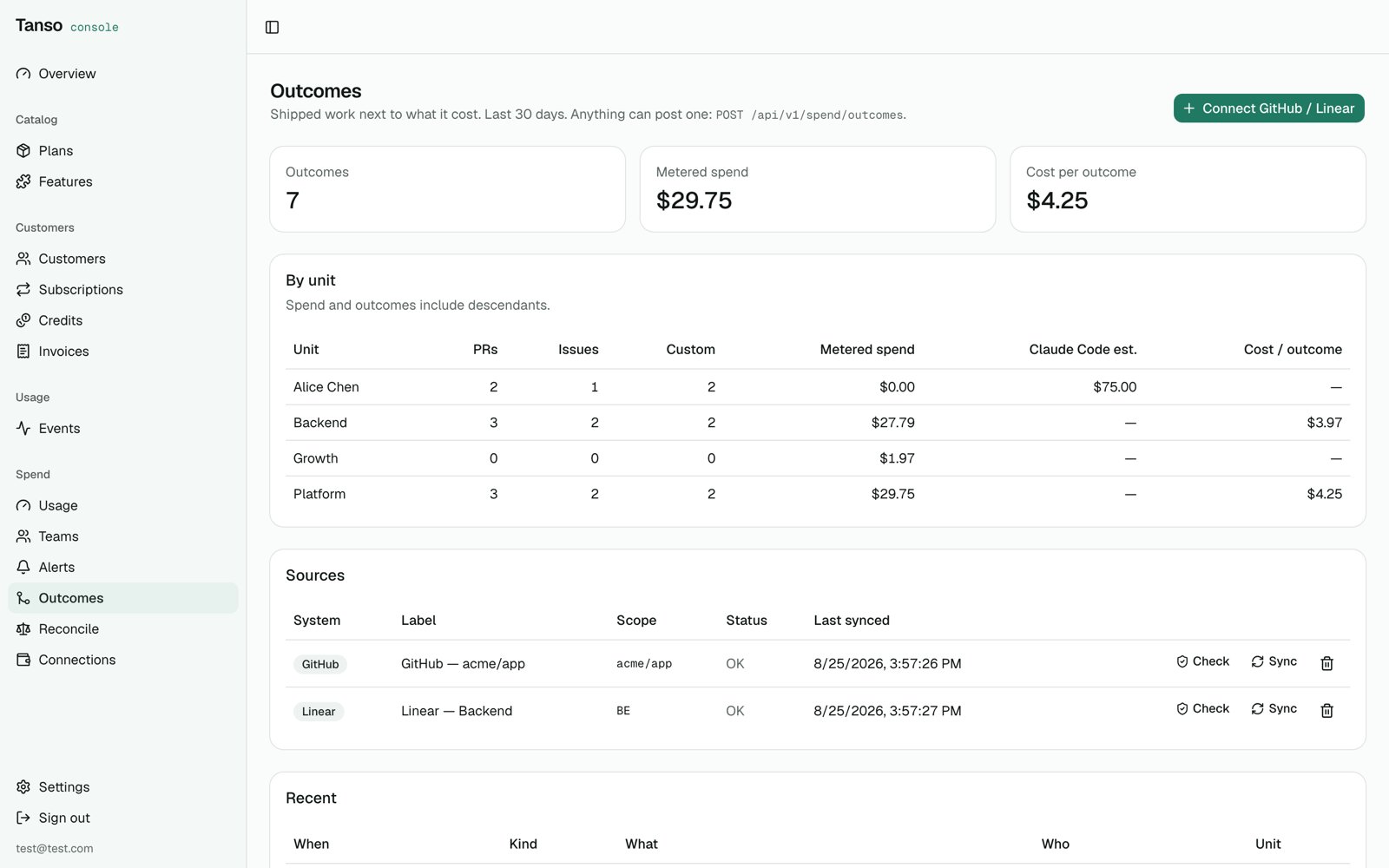 **Spend → Outcomes** puts shipped work next to what it cost. An outcome is a
merged pull request, a completed issue, or whatever you say it is.
**Pulled.** Connect GitHub (a fine-grained token with read access to pull
requests; scope is a comma-separated `owner/repo` list such as
`acme/app, acme/site`) or Linear (an API key; scope is comma-separated team
keys such as `BE, FE`, or `*` for every team). The token is checked when you
connect, so a bad one shows `ERROR` immediately. Sync pulls merged PRs /
completed issues for the window and re-pulls upsert; an hourly job covers the
last three days. Disconnecting a source removes the outcomes it pulled;
posted ones stay. A person's GitHub login goes on their PERSON unit under
Teams so merged PRs attribute to them.
**Posted.** Any CI job or script can record one with the tenant API key —
the same `sk_` key that ingests events. Customer `ck_` keys are refused:
this is your spend, not a customer's.
```bash theme={null}
curl -X POST https://YOUR-INSTANCE/api/v1/client/outcomes \
-H "X-API-Key: $TANSO_API_KEY" -H 'Content-Type: application/json' \
-d '{"kind":"CUSTOM","externalId":"deploy-2026-08-25-1","title":"Prod deploy","url":"https://ci/…","actorEmail":"alice@acme.com"}'
```
Fields: `kind` (`PR_MERGED`, `ISSUE_DONE`, `CUSTOM`) and `externalId` are
required; `title`, `url`, `actorEmail`, `actorLogin`, `spendUnitId` and
`occurredAt` (default now) are optional. Posting the same `externalId` again
updates only the fields you send. The console route
`POST /api/v1/spend/outcomes` takes the same body with a JWT.
**Attribution.** An outcome lands on the person whose email or GitHub login
matches (person level on), else on the source's default unit, else on the
unit you passed. Outcomes with no unit are counted and called out.
**AI-assisted.** A merged pull request is tagged AI-assisted, with the tool,
when GitHub already says so: a `claude-code-assisted`, `copilot` or `cursor`
label, a `Co-authored-by: Claude` / `Made-with: Cursor` trailer in the body,
or a bot author. Posted outcomes can say so with `aiAssisted` and `aiTool`.
Absence is not evidence — an untagged PR is unknown, not human. The report
counts AI-assisted outcomes per unit.
**Report.** Per unit, metered spend (with descendants) over outcomes (with
descendants): cost per merged PR, per team, per window. A person's Claude
Code estimate is shown beside the metered figure, never inside it, so every
row divides the same kind of number. Cost per outcome is empty when a unit
shipped nothing or has no metered spend to divide. **Recent** lists the last
200 outcomes regardless of window.
```bash theme={null}
GET /api/v1/spend/reports/outcomes?from=&to=
```
## 7. Savings: what caching is worth, what a route would cost
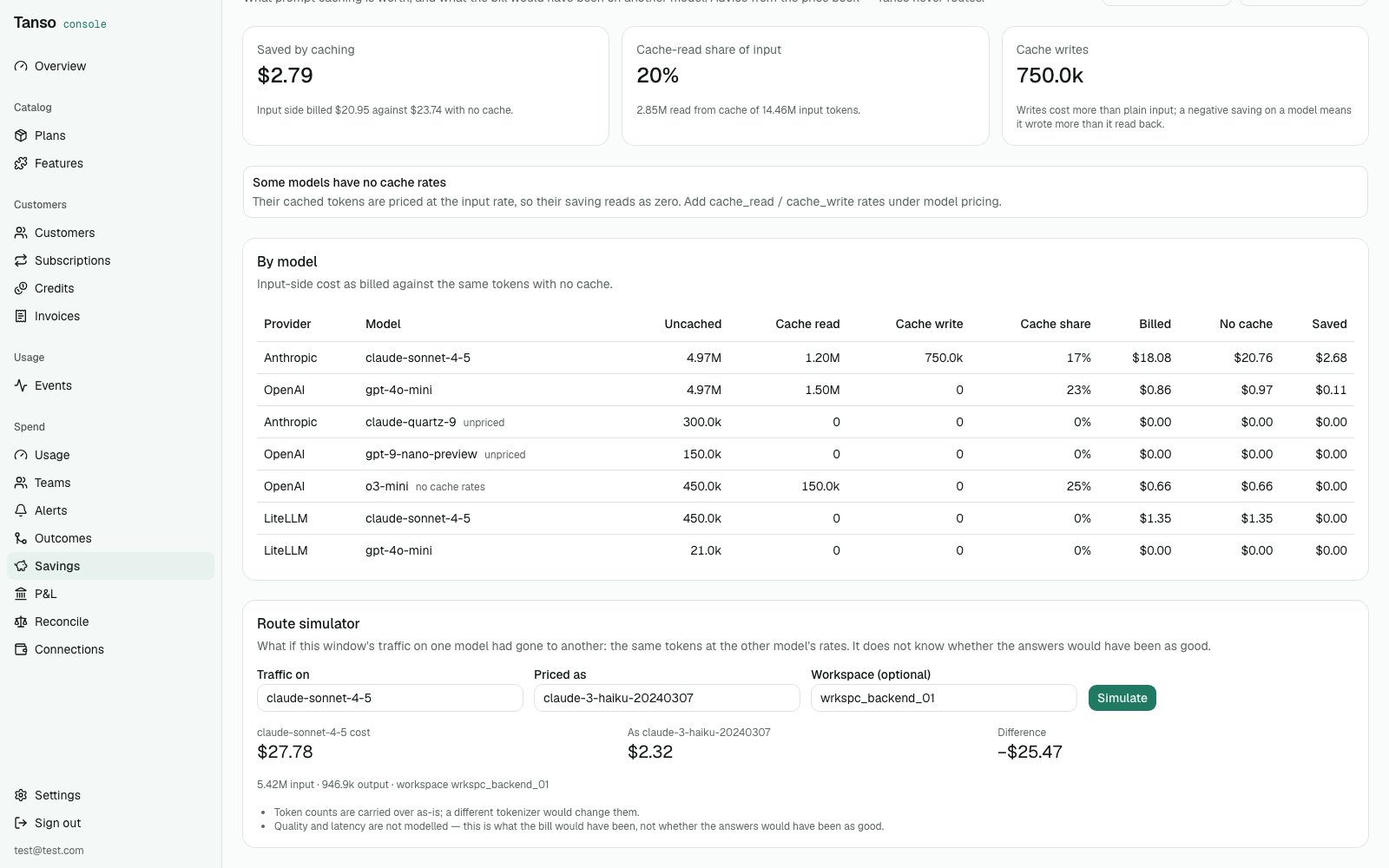
**Spend → Savings.** Per model, the input side of the bill as it was billed —
uncached tokens at the input rate, cache reads and writes at theirs — against
the same tokens with no cache. The difference is what prompt caching saved;
it goes negative on a model that wrote more to the cache than it read back.
Cache-read share is reads over all input tokens.
A model with no cache rates in the price book is priced at its input rate for
cached tokens, so its saving reads as zero and the row says *no cache rates*
— add `cache_read_cost_per_million` / `cache_write_cost_per_million` under
model pricing.
**Spend → Outcomes** puts shipped work next to what it cost. An outcome is a
merged pull request, a completed issue, or whatever you say it is.
**Pulled.** Connect GitHub (a fine-grained token with read access to pull
requests; scope is a comma-separated `owner/repo` list such as
`acme/app, acme/site`) or Linear (an API key; scope is comma-separated team
keys such as `BE, FE`, or `*` for every team). The token is checked when you
connect, so a bad one shows `ERROR` immediately. Sync pulls merged PRs /
completed issues for the window and re-pulls upsert; an hourly job covers the
last three days. Disconnecting a source removes the outcomes it pulled;
posted ones stay. A person's GitHub login goes on their PERSON unit under
Teams so merged PRs attribute to them.
**Posted.** Any CI job or script can record one with the tenant API key —
the same `sk_` key that ingests events. Customer `ck_` keys are refused:
this is your spend, not a customer's.
```bash theme={null}
curl -X POST https://YOUR-INSTANCE/api/v1/client/outcomes \
-H "X-API-Key: $TANSO_API_KEY" -H 'Content-Type: application/json' \
-d '{"kind":"CUSTOM","externalId":"deploy-2026-08-25-1","title":"Prod deploy","url":"https://ci/…","actorEmail":"alice@acme.com"}'
```
Fields: `kind` (`PR_MERGED`, `ISSUE_DONE`, `CUSTOM`) and `externalId` are
required; `title`, `url`, `actorEmail`, `actorLogin`, `spendUnitId` and
`occurredAt` (default now) are optional. Posting the same `externalId` again
updates only the fields you send. The console route
`POST /api/v1/spend/outcomes` takes the same body with a JWT.
**Attribution.** An outcome lands on the person whose email or GitHub login
matches (person level on), else on the source's default unit, else on the
unit you passed. Outcomes with no unit are counted and called out.
**AI-assisted.** A merged pull request is tagged AI-assisted, with the tool,
when GitHub already says so: a `claude-code-assisted`, `copilot` or `cursor`
label, a `Co-authored-by: Claude` / `Made-with: Cursor` trailer in the body,
or a bot author. Posted outcomes can say so with `aiAssisted` and `aiTool`.
Absence is not evidence — an untagged PR is unknown, not human. The report
counts AI-assisted outcomes per unit.
**Report.** Per unit, metered spend (with descendants) over outcomes (with
descendants): cost per merged PR, per team, per window. A person's Claude
Code estimate is shown beside the metered figure, never inside it, so every
row divides the same kind of number. Cost per outcome is empty when a unit
shipped nothing or has no metered spend to divide. **Recent** lists the last
200 outcomes regardless of window.
```bash theme={null}
GET /api/v1/spend/reports/outcomes?from=&to=
```
## 7. Savings: what caching is worth, what a route would cost
**Spend → Savings.** Per model, the input side of the bill as it was billed —
uncached tokens at the input rate, cache reads and writes at theirs — against
the same tokens with no cache. The difference is what prompt caching saved;
it goes negative on a model that wrote more to the cache than it read back.
Cache-read share is reads over all input tokens.
A model with no cache rates in the price book is priced at its input rate for
cached tokens, so its saving reads as zero and the row says *no cache rates*
— add `cache_read_cost_per_million` / `cache_write_cost_per_million` under
model pricing.
 ### Route simulator
"What if the traffic on claude-opus-4-1 had gone to claude-sonnet-4-5?" Pick
the model whose traffic to re-price, a target from the price book, and
optionally one vendor workspace / project / team id. Tanso sums the matched
tokens and prices them at both models' rates:
```http theme={null}
POST /api/v1/spend/reports/simulate
{"from":"2026-08-01","to":"2026-08-26","fromModel":"claude-opus-4-1","toModel":"claude-sonnet-4-5","workspaceId":"wrkspc_backend_01"}
```
The answer carries `currentCents`, `simulatedCents`, `deltaCents` and a list
of `caveats` that is never empty: token counts are carried over as-is (a
different tokenizer would change them), quality and latency are not
modelled, and it says when the target has no cache rates or a model was
matched fuzzily. It is advice from the price book. Tanso does not route
requests and will not — that was decided before internal spend was started.
## 8. Feature P\&L: what it cost to build next to what it earns
### Route simulator
"What if the traffic on claude-opus-4-1 had gone to claude-sonnet-4-5?" Pick
the model whose traffic to re-price, a target from the price book, and
optionally one vendor workspace / project / team id. Tanso sums the matched
tokens and prices them at both models' rates:
```http theme={null}
POST /api/v1/spend/reports/simulate
{"from":"2026-08-01","to":"2026-08-26","fromModel":"claude-opus-4-1","toModel":"claude-sonnet-4-5","workspaceId":"wrkspc_backend_01"}
```
The answer carries `currentCents`, `simulatedCents`, `deltaCents` and a list
of `caveats` that is never empty: token counts are carried over as-is (a
different tokenizer would change them), quality and latency are not
modelled, and it says when the target has no cache rates or a model was
matched fuzzily. It is advice from the price book. Tanso does not route
requests and will not — that was decided before internal spend was started.
## 8. Feature P\&L: what it cost to build next to what it earns
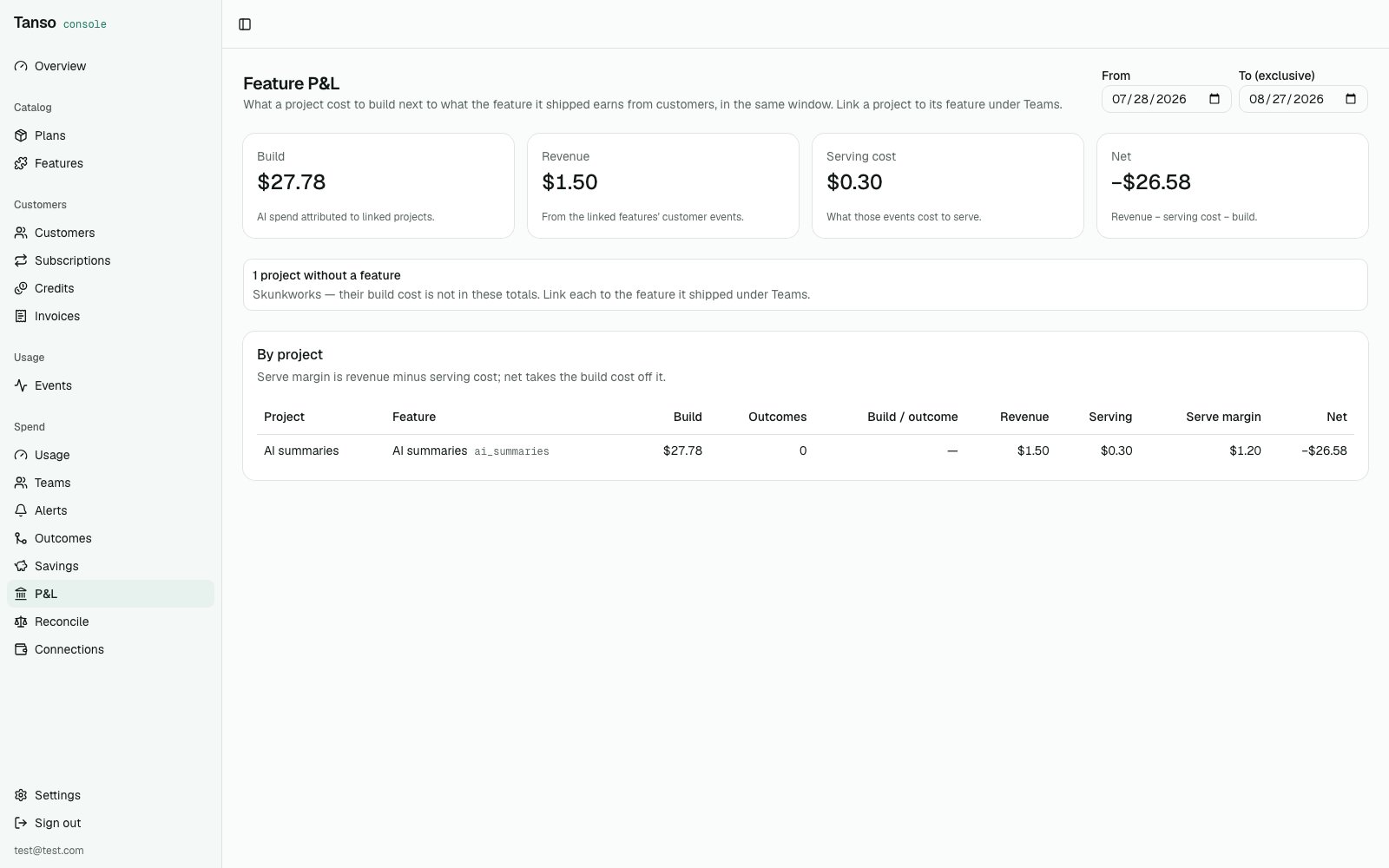 This is the join the two halves of the engine exist for. Internal spend knows
what a project cost in AI spend; monetization knows what a feature earns
from customers and what serving it costs. Link them and one report shows
both.
1. **Spend → Teams**, open (or create) a *project* unit and pick the feature
it shipped under **Feature** — the same features monetization prices in
plans.
2. **Spend → P\&L** (`GET /api/v1/spend/reports/pnl?from&to`): per project,
its attributed AI spend with descendants (*build*), what it shipped
(outcomes), and from the feature's customer events in the same window:
revenue, serving cost, serve margin, and **net** = serve margin − build.
Build cost per outcome is there too.
Projects without a feature are listed under *unlinked* rather than hidden,
and their build cost is not in the totals — a P\&L with half the ledger is
worse than none. Revenue and serving cost come from `revenueAmount` /
`costAmount` on `CLIENT_TRACKED` and `ENTITLEMENT_CHECKED` events, so a
feature that is entitled but never metered reads as zero revenue, not as
missing.
## Outbound URLs
Two things the operator types are URLs the server will call: the LiteLLM
proxy and the generic webhook. Both are checked when saved: `http(s)` only,
no credentials in the URL, the host must resolve, and loopback, link-local
(where cloud metadata services live) and unspecified addresses are refused.
Private ranges are allowed by default — a self-hosted proxy is exactly what
sits there; on a multi-tenant install set `APP_SPEND_OUTBOUND_ALLOW_PRIVATE=false`.
Errors from the proxy are surfaced as its JSON `error.message` / `detail`
only, never a raw response body.
## Settings and operations
| Setting | Where | Notes |
| ------------------------------------------------------------------------------------ | ---------------------------- | ------------------------------------------------------------------------- |
| `APP_SECRETS_KEY` | env | Required. Encrypts stored credentials. See [self-hosting](/self-hosting). |
| `APP_MODULES_BUILD_ENABLED` | env | `false` for a serve-side-only install. |
| `APP_SPEND_ANTHROPIC_BASE_URL` etc. (`_OPENAI_`, `_CURSOR_`, `_GITHUB_`, `_LINEAR_`) | env | Point a pull at a gateway or proxy instead of the vendor. |
| Person level, worker notice, Slack webhook | `PUT /api/v1/spend/settings` | Console: Spend → Teams → Spend settings. |
Jobs (`application.yaml` → `jobs:`): `vendorUsageSync` hourly at :15,
`spendBudget` at :30, `outcomeSync` at :45. All ShedLock-guarded.
## Limitations
* Blocking is advisory unless a LiteLLM connection and rule exist; daily
ceilings are never pushed.
* Email needs a Resend key on the server; there is no SMTP path.
* P\&L revenue is event revenue, not invoiced revenue — flat plan fees that
are not attributed to a feature do not appear on it.
* OpenAI's `group_by` parameter format was verified against OpenAI's cookbook,
not a live admin key — check per-model rows against your dashboard once.
* Employee self-view and a manager cohort minimum are not built; person-level
data is visible to every console user once enabled.
* Jira is not pulled; post outcomes from CI in the meantime.
* Cursor's admin API is Enterprise-only; Teams plans cannot connect it.
This is the join the two halves of the engine exist for. Internal spend knows
what a project cost in AI spend; monetization knows what a feature earns
from customers and what serving it costs. Link them and one report shows
both.
1. **Spend → Teams**, open (or create) a *project* unit and pick the feature
it shipped under **Feature** — the same features monetization prices in
plans.
2. **Spend → P\&L** (`GET /api/v1/spend/reports/pnl?from&to`): per project,
its attributed AI spend with descendants (*build*), what it shipped
(outcomes), and from the feature's customer events in the same window:
revenue, serving cost, serve margin, and **net** = serve margin − build.
Build cost per outcome is there too.
Projects without a feature are listed under *unlinked* rather than hidden,
and their build cost is not in the totals — a P\&L with half the ledger is
worse than none. Revenue and serving cost come from `revenueAmount` /
`costAmount` on `CLIENT_TRACKED` and `ENTITLEMENT_CHECKED` events, so a
feature that is entitled but never metered reads as zero revenue, not as
missing.
## Outbound URLs
Two things the operator types are URLs the server will call: the LiteLLM
proxy and the generic webhook. Both are checked when saved: `http(s)` only,
no credentials in the URL, the host must resolve, and loopback, link-local
(where cloud metadata services live) and unspecified addresses are refused.
Private ranges are allowed by default — a self-hosted proxy is exactly what
sits there; on a multi-tenant install set `APP_SPEND_OUTBOUND_ALLOW_PRIVATE=false`.
Errors from the proxy are surfaced as its JSON `error.message` / `detail`
only, never a raw response body.
## Settings and operations
| Setting | Where | Notes |
| ------------------------------------------------------------------------------------ | ---------------------------- | ------------------------------------------------------------------------- |
| `APP_SECRETS_KEY` | env | Required. Encrypts stored credentials. See [self-hosting](/self-hosting). |
| `APP_MODULES_BUILD_ENABLED` | env | `false` for a serve-side-only install. |
| `APP_SPEND_ANTHROPIC_BASE_URL` etc. (`_OPENAI_`, `_CURSOR_`, `_GITHUB_`, `_LINEAR_`) | env | Point a pull at a gateway or proxy instead of the vendor. |
| Person level, worker notice, Slack webhook | `PUT /api/v1/spend/settings` | Console: Spend → Teams → Spend settings. |
Jobs (`application.yaml` → `jobs:`): `vendorUsageSync` hourly at :15,
`spendBudget` at :30, `outcomeSync` at :45. All ShedLock-guarded.
## Limitations
* Blocking is advisory unless a LiteLLM connection and rule exist; daily
ceilings are never pushed.
* Email needs a Resend key on the server; there is no SMTP path.
* P\&L revenue is event revenue, not invoiced revenue — flat plan fees that
are not attributed to a feature do not appear on it.
* OpenAI's `group_by` parameter format was verified against OpenAI's cookbook,
not a live admin key — check per-model rows against your dashboard once.
* Employee self-view and a manager cohort minimum are not built; person-level
data is visible to every console user once enabled.
* Jira is not pulled; post outcomes from CI in the meantime.
* Cursor's admin API is Enterprise-only; Teams plans cannot connect it.